




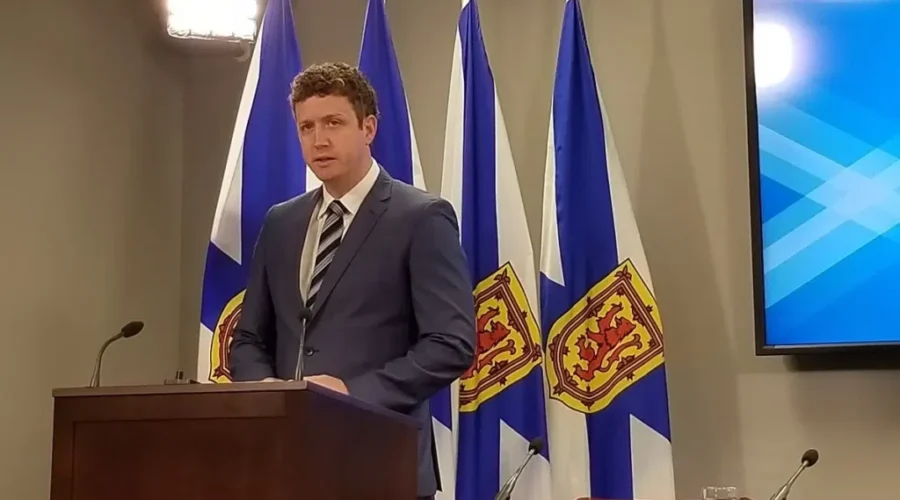
Nova Scotia’s Minister of Lands and Forestry Iain Rankin has responded to an Op-Ed he released on the state of Forestry in the province.
In the Op-Ed, Rankin called for change to be made in the industry by looking at ways of creating better biodiversity and modernizing management of forests.
Rankin said the Op-Ed came from feedback he heard from both those in the forestry sector and those concerned about the environment.
“It’s important to try and bring those two different perspectives together to value the forestry industry and also value the protection of bio diversity,” he said to reporters at a press conference.
“I think when you’re trying to balance economy and environment, I was making the point that environment has to be there. It is in everyone’s best interest that the protection of ecosystems is there in the long term.”
In the Op-Ed, Rankin points out the difference made within the sector after implementing a retention guide on tree harvesting in December, and talks about the provinces use of clear-cutting as the default approach, something he hopes can change.
When asked if he believes environment trumps economy when it comes to forestry at the end of the day, he said a balance needs to be found.
“You can see now that across the globe, biodiversity is under threat,” he said.
“We are doing a pretty good job in terms of protecting important lands and ecosystems, we could do more. We also have to ensure we are respecting the way of life for many Nova Scotians, over 10,000 that are reliant on this sector. What I was trying to get at is it’s in their interest as well that we look at a sustainable path forward as we modernize and improve our environmental safeguards.”
Rankin’s full Op-Ed can be read below.
Forestry has been part of the foundation of our economy for many decades and has experienced significant changes over time.
It is time for this industry to change once again.
A cultural shift is underway that will transform how we value and manage our forests. It’s a move that fully embraces the true meaning of ecological forestry.
This industry needs to bridge the divide between a sustainable path forward and achieving better environmental standards.
At times, I hear misunderstanding from all sides in this sector. However, I am optimistic we can reach a place where everyone involved sees the importance of increasing our efforts to conserve biodiversity and wildlife.
We will get there by being thoughtful, respectful and most importantly by working together. I believe we will find a practical plan that will deliver better ecological outcomes in the forest.
We will preserve the richest biodiversity we have by focusing more on multi-age management of the forest and preserving long-lived, mixed species.
It is not simply about balancing economy and environment because without the environment there is no economy.
Already, we can see real improvements are starting to happen in our forests by putting the focus on ecology and biodiversity first.
Since December, we’ve been using a retention guide on tree harvesting that puts greater focus on preservation when harvest decisions are being made. Over the summer we will update that guide with valuable feedback from our stakeholders.
We also have project management teams that include the people who were instrumental in offering advice to the guide’s main author, Prof. William Lahey.
This sector is important for the generations of families that have been employed throughout the province.
It’s also a key part of products we all use daily in our homes and offices like furniture, paper products and building materials.
In order to improve the way we respect the biodiversity of the forest, we need to recognize that industry is willing to modernize and adapt again.
Government’s role is to create the conditions for mutual respect. This requires patience and perseverance. If we are successful, we all benefit.
The United Nations recognizes that biodiversity is under threat in every region of the world. That means everyone – communities, industry, non-governmental organizations and First Nations – has a role to play in protecting it.
The Mi’kmaq are now answering that call by managing more than 20,000 hectares of land, which was a key recommendation in the Lahey report.
On June 25, we held our first broad stakeholder engagement session, and it was clear that Nova Scotians want to work together to achieve the goals of that report.
By following the most up-to-date science, we can improve conservation efforts while respecting the need for products we all use. It’s in all of our interests that greater consideration be given not only to species at risk, but to all wildlife habitat.
Today, we still use clearcutting as the default approach far too often. There is a place for this approach, but only when the science shows that it can be, “ecologically acceptable in certain circumstances”, as many stakeholders have suggested. For now, our guidelines work to retain the most important trees.
I realize that leaving our partners in the dark evaporates trust and faith. That’s why I will always welcome respectful feedback that focuses on this very important task.
Together we can meet the challenge of nurturing a healthy forest, respecting one of the oldest industries in Nova Scotia and ensuring our children can enjoy one of the most diverse ecosystems in the world.
Reported by: Cody McEachern
Twitter: @CodyInHiFi
E-mail: mceachern.cody@radioabl.ca


