



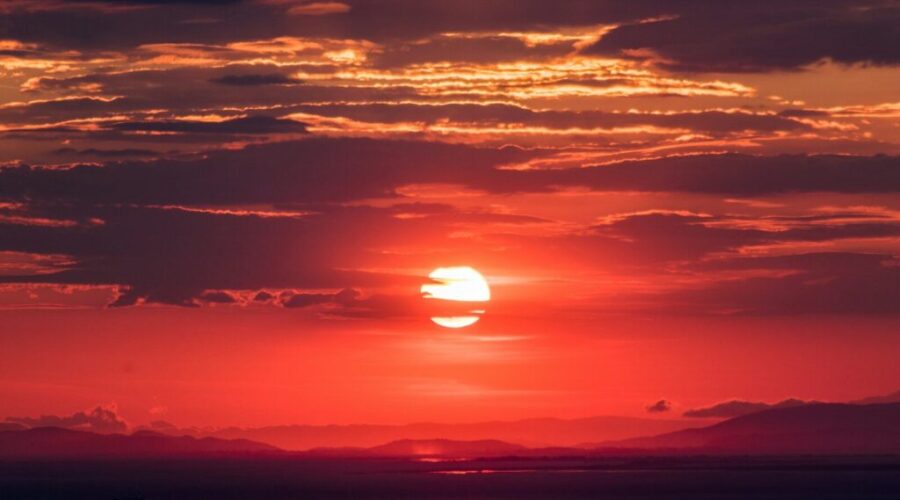
Have you ever noticed that some sunsets stop you in your tracks while others seem to quietly fade away?
It turns out there’s a reason for that, and it’s actually pretty incredible.
Scientists say no two sunsets are exactly alike because the colours we see depend on a constantly changing mix of atmospheric conditions. Things like dust, moisture, cloud cover, air pollution, smoke from distant wildfires, and even tiny salt particles from the ocean can all affect how sunlight travels through the atmosphere.
During the day, sunlight appears white, but it’s actually made up of every colour in the visible spectrum. As the sun gets lower on the horizon, its light has to travel through much more of Earth’s atmosphere before reaching our eyes.
The shorter wavelengths, blues and violets, scatter away first. That’s why the sky appears blue during the day. By sunset, much of that blue light has already been scattered out, allowing the longer wavelengths like reds, oranges, and pinks to dominate the sky.
That’s only part of the story.
The atmosphere acts almost like a giant natural filter. A dry, clear evening might produce a soft yellow or golden sunset. Add the right amount of moisture and high clouds, and suddenly the sky can explode with shades of orange, red, purple, and pink.
Clouds themselves play a huge role. High-altitude clouds can catch sunlight long after the sun has dipped below the horizon, creating those dramatic glowing skies that people rush to photograph.
Sometimes the best sunsets happen after unusual events. Volcanic eruptions, large dust storms, and even wildfire smoke can inject particles high into the atmosphere, leading to exceptionally vivid colours that can be seen hundreds or even thousands of kilometres away.
Living in Atlantic Canada adds another layer to the experience.
The combination of ocean air, changing weather patterns, and wide-open coastal views can create spectacular sunset conditions throughout the year. One evening might bring fiery reds over the Bay of Fundy, while the next paints the sky in soft pastel colours along the coast of Cape Breton.
What’s really amazing is that a sunset is essentially a snapshot of the atmosphere at that exact moment. Every particle of dust, every water droplet, every cloud, and every shift in air conditions contributes to the final picture.
That’s why the sunset you see tonight has never happened before, and will never happen exactly the same way again.
It’s one of nature’s most beautiful daily reminders that even familiar things can be completely unique.