



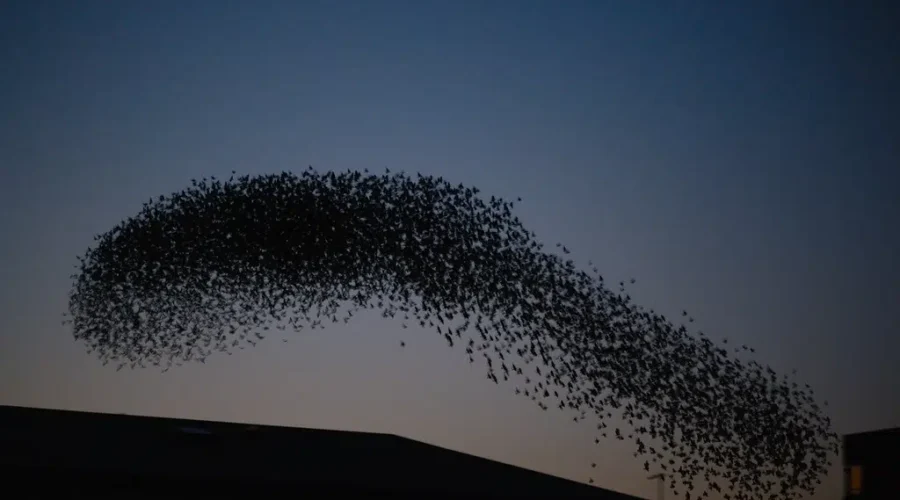
I caught site of a murmuration the other evening. Not a big murmuration. They can get pretty darn large at times. This was a smaller murmuration, but still impressive to watch.
If you’re not familiar, a murmuration is when you get an entire flock of birds all flying as one big cloud. They all seem to make the same twists and turns at the same time for no apparent reason. It’s pretty impressive to watch, but not all that uncommon.
But not all birds do it. There are a few seabirds that get into the synchronized flying thing. And starlings. Starlings seem to be fairly regular at doing murmurations.
When you seem them, starlings are pretty drab looking. Just medium sized black birds. Only they’re not really black. And far from drab. They are actually black birds with white spots and iridescent feathers that almost appear to change colours with different angles. And in spite of the fact that we seem to have them everywhere, they’re not really from here.
The fact that we have starlings around here could be Shakespeare’s fault, although no one is quite sure. When they first started to appear, people were not big fans of starlings. There was a rumour going around that a man named Eugene Schieffelin who had been a successful businessman, decided that North America needed every bird mentioned in the writings of William Shakespeare. He was the head of what was known as the American Acclimatization Society, and they apparently set about doing this.
First, they had to go through all the works of Shakespeare. There are about sixty different species of birds mentioned in his works. In Henry IV, Act 1, the starling is mentioned as being trained to annoy the king. Once. But it was enough that this organization thought we needed them here. So they brought some in. Along with a few other species that bard had mentioned.
No one is quite sure if this is totally true, but since Shakespeare isn’t around to defend himself, why not blame him?
Anyway, they’re here now. And they do this neat flying trick called a murmuration. No one is quite sure why they do it. They may be acting like that to scare off predators before they roost for the night. Or maybe to call other starlings and let them know it’s bedtime. But getting near dusk it’s not unusual to see a group of starlings flying around as one.
It’s impressive. And fun to watch. And whether it’s true or not, I’m blaming Shakespeare.