




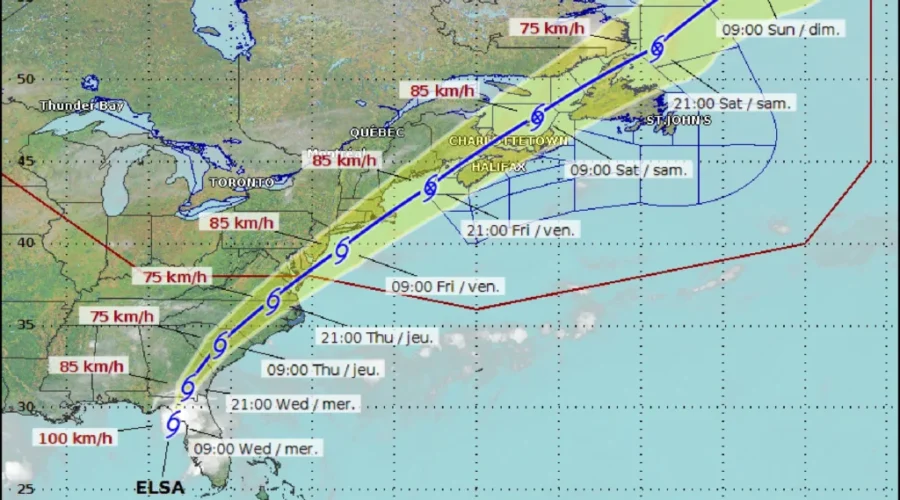
Tropical storm Elsa could bring quite a bit of rain and gusty winds to parts of the Maritimes later this week.
Elsa made landfall along the north Florida Gulf Coast on Wednesday morning packing wind speeds of 100 km/h.
Forecasters say the tropical system could bring more than 200 millimetres of rain to parts of the Sunshine State.
It is now expected to track across the southeastern United States before moving back into the Atlantic Ocean and taking aim at the Maritimes.
“What happens between the landfall and when it actually emerges off the coast of the Carolinas is going to be the key indicator as to what we might get here in the Maritimes,” Bob Robichaud, a meteorologist at the Canadian Hurricane Centre, said in an interview Wednesday morning.
“If it stays reasonably intact, we could see a slightly stronger storm and more potential for restrengthening. If it has a hard time surviving the trek over land, then we might be looking at a weaker storm by the time it gets here.”
The current forecast from the Canadian Hurricane Centre has the centre of Elsa tracking up through the Bay of Fundy on Friday as a post-tropical storm.
But the “cone of uncertainty” indicates it could track anywhere from offshore Nova Scotia to even central New Brunswick.
Robichaud said the final track of the storm will be a determining factor where the heaviest rain and strongest winds will occur.
“If you look in the direction the storm is going, to the left of that would be the heaviest rain and your gusty winds would be on the right-hand side of the track,” he said.
On the current track, Robichaud said southern New Brunswick could see more than 50 millimetres of rain while coastal areas of Nova Scotia could see wind gusts up to 70 kilometres per hour.
The Canadian Hurricane Centre issued its first tropical cyclone information statement for Elsa on Wednesday morning and Robichaud said it will be updated every six hours with the latest information.
The @ECCC_CHC has begun issuing bulletins on Tropical Storm Elsa which is expected to approach Atlantic Canada late Friday. The latest information can be found at https://t.co/Iyohs0e8hK.
pic.twitter.com/89yXc8i70h
— ECCC Canadian Hurricane Centre (@ECCC_CHC) July 7, 2021


