




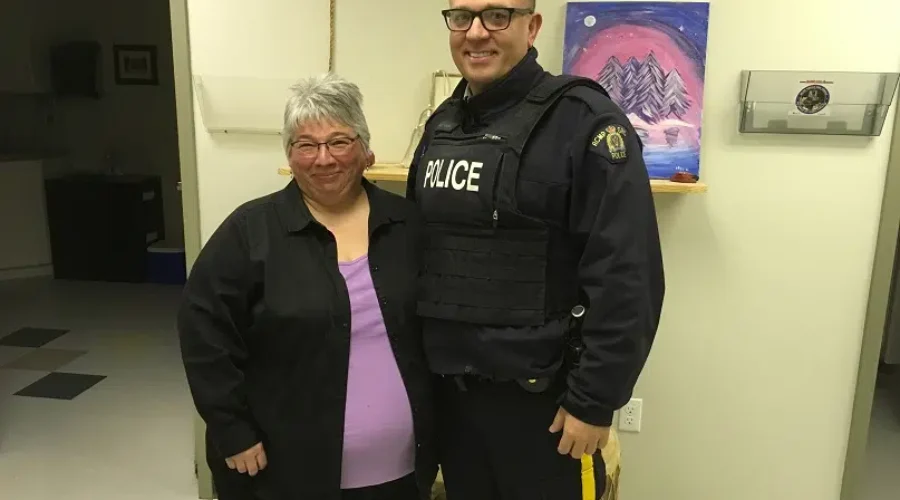
Lunenburg District RCMP and Gold River Reserve have partnered to create what may be a first of its kind youth program.
After receiving a donation from local businessman John Risley, the Eagle Feather Youth Group was formed.
Risley gave the donation to the RCMP Foundation with the condition it be used for indigenous youth programming.
The after school group will see kids Grade 6 – 8 learn about their heritage and the ins and outs of the RCMP.
Rod Francis, is a Mi’kmaq RCMP constable and a School Safety Officer.
He had already been sitting in on some of Acadia First Nation’s Gold River Reserve’s after school programs, where Francis says he taught youth cyber safety and crime prevention and learned from the students.
“And (I would) sit with the kids and make crafts, they were teaching me something about my culture and my heritage because they had been learning it for so long.”
After receiving the donation, Francis realized they could create a whole program based on that model.
Sheila Porter, a Mi’kmaq student support worker with South Shore Regional School Board, conducts after school programs for Gold River Reserve.
Porter says the program will help build trust with law enforcement and keep the students’ culture alive.
“I think it’s very important to have that door swinging both ways and I think it’s a win-win situation for our children and hopefully down the road, we can change those relationships to be good relationships.”
Porter says the trust is important but the cultural side is equally important, adding that Gold River has been working hard to pass tradition down to their youth, particularly with their big annual powwow – some of her students have learned to dance and drum.
“We have the ripple effect of the residential school survivors, the residential school results and these children are the rippling effect of some of their parents, grandparents, so we need to bring their culture back, we need to bring their language back,” she says.
Each of the seven sessions will feature ‘cultural reflections’ where students will make traditional crafts or take part in cultural experiences like talking circles.
They’ll also get a ‘Mountie moment’ where they’ll learn something from RCMP like forensic sciences or about police dogs.
Or they might talk about something collectively like role models, and what makes a good one.
They’ll also take trips and have healthy snacks.
The program fills a gap that they had, where their after school programming only went up to Grade 5.
“Ages 12 to 14 is a really vulnerable age and it’s great to have that cultural piece with them,” says Porter.
Both Porter and Francis are excited to roll out the new program.
Francis hopes it leads to more indigenous representation in the RCMP and builds trust between law enforcement and indigenous communities.
He believes this is the first program of its kind and hopes other areas might work on something similar.
The program runs weekly from March 21 to May 23 and will restart in September and run throughout the school year.
The aim is to open it up to indigenous students who live off reserve as well.
And although the youth group’s name, Eagle Feather, may have been coincidental – one of the students came up with it – it does have significance.
The Nova Scotia RCMP announced in October that all clients – victims, witnesses and police officers have the option to swear legal oaths on an eagle feather and it can be used to offer comfort to people seeking services at a detachment.


