



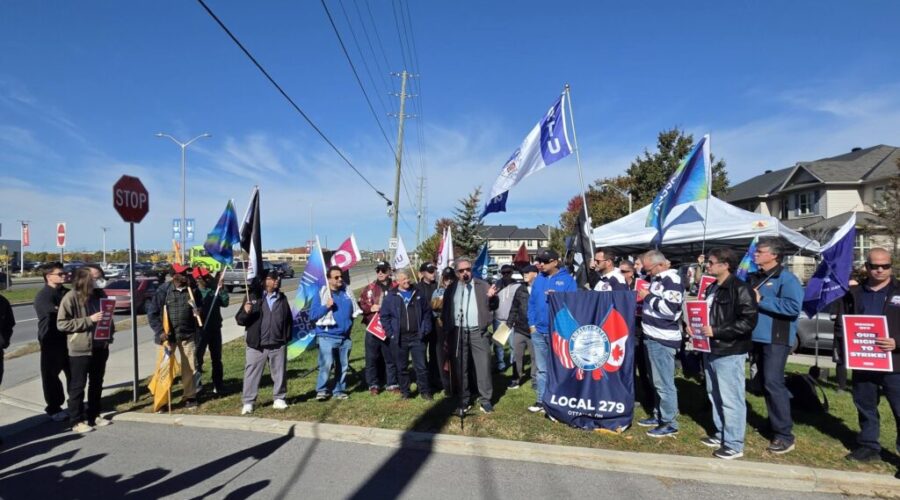
Labour groups across Canada rallied outside MPs’ offices as part of a national day of action aimed at raising awareness of Bill C-39, which union leaders say threatens workers’ constitutional right to strike.
The demonstrations, organized by the Canadian Labour Congress (CLC) and local labour organizations, took place in communities across the country. According to CLC Executive Vice-President Siobhán Vipond, the events were designed to encourage workers to contact their elected representatives about concerns with the legislation.
“We wanted to make sure that people understood this is an important issue to workers,” Vipond said. “Our economy depends on strong unions, so we depend on the government to uphold our right to strike.”

The focus of the protests is a provision within Bill C-39 that would amend Section 107 of the Canada Labour Code. Labour groups argue the changes would give the federal government greater authority to intervene in labour disputes involving federally regulated workers, effectively weakening the right to strike.
Vipond said that while unions support some aspects of the bill, they oppose any measure that would limit workers’ ability to withdraw their labour during collective bargaining disputes.
“Our constitutional rights deserve to be protected,” she said. “There’s a way to get the good stuff in this bill passed, and that is to not take away our right to strike.”
Federally regulated workers account for roughly 10 per cent of Canada’s workforce, but support for Thursday’s demonstrations extended beyond those directly affected, Vipond said.
Unions representing provincially regulated workers also participated
“When we start taking rights away, we know it’s only a matter of time before provinces are also going to say, ‘If the federal government doesn’t need to protect the right to strike, why do we need to protect the right to strike?'” Vipond said.
She argued that the ability to strike is essential to collective bargaining because it helps balance the power between workers and employers.
“The right to strike is fundamentally important,” she said. “Without it, you can’t have meaningful bargaining in the collective bargaining process.”
While final turnout numbers were not immediately available, Vipond said early reports suggested strong participation in several cities, including St. John’s, Toronto, Saint John, Moncton, Thunder Bay and Ottawa. She added that many workers who were unable to attend rallies pledged to write letters or contact their MPs instead.
The federal government has defended the proposed legislation, arguing it would benefit workers and unions. However, Vipond said labour organizations remain unconvinced.
“We know that’s not true because taking rights away is not good,” she said.
Vipond said some MPs who met with union representatives appeared unfamiliar with labour’s concerns and welcomed additional information about the legislation.
The day of action is part of a broader campaign that has included meetings with MPs, letter-writing efforts and phone calls to elected officials.
The bill has already passed second reading and will next move to committee review, where labour organizations are expected to present their concerns directly to parliamentarians.
Unions are prepared to continue escalating pressure if nothing changes
“What’s next is we’re going to continue that pressure,” she said. “We’re going to look at everything that’s on the table and ramp up if we’re not getting a good response from government.”
For labour groups, she said, the issue goes beyond a single piece of legislation.
“This is such a huge issue,” Vipond said. “The Supreme Court of Canada recognized the right to strike because it is so important. We expect government to protect that right.”